Why choose a large industrial fan for your facility? The answer begins with airflow, not appearance. In a busy warehouse, heat can collect beneath the roof while stagnant air surrounds workers and equipment. A properly selected large industrial fan can move this trapped air across wide floor areas. It may improve comfort, reduce temperature layering, and support more consistent ventilation.
The right model depends on more than diameter. Facility managers should review ceiling height, floor layout, humidity, dust levels, occupancy, and existing HVAC capacity. Engineers also consider airflow volume, static pressure, motor efficiency, noise, controls, and maintenance access. A fan that looks powerful may perform poorly in a crowded building. That mistake is common.
Walk the space first.
In practice, I have seen airflow change significantly after relocating storage racks or opening a loading door. These details matter. Reliable manufacturers publish performance data and testing information, helping buyers compare operating conditions rather than marketing claims. Professional installation also matters because mounting, electrical connections, guarding, and control settings affect safety and performance. Local codes and qualified inspections should guide the final installation.
A large industrial fan is not automatically the best solution. Smaller units, exhaust systems, or improved insulation may solve certain problems more effectively. However, when a facility needs broad, steady air movement, a carefully specified fan can become a practical long-term investment. The strongest decision combines measured site conditions, experienced advice, realistic energy expectations, and a maintenance plan that people will actually follow.
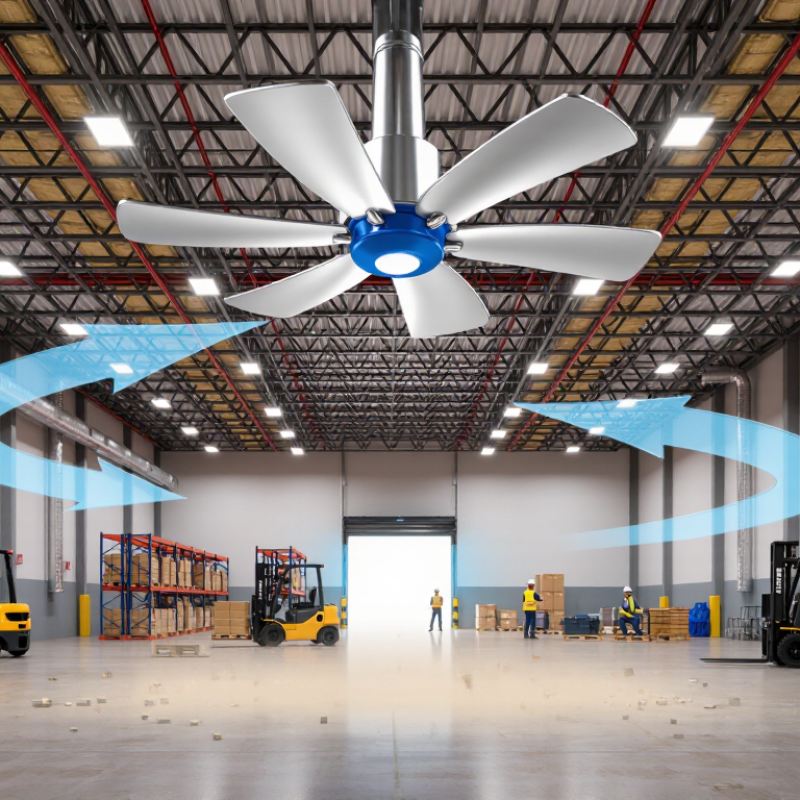
A large industrial fan is a high-capacity machine that moves air through warehouses, workshops, factories, and agricultural buildings. Unlike a household fan, it is built for long operating hours and demanding environments. Its motor turns the blades, creating a pressure difference that pushes air across a wide area. Axial fans move air parallel to the shaft, while centrifugal fans redirect air outward. The distinction matters when a facility needs ventilation, cooling, or pressure control.
In a warehouse, warm air often collects beneath the roof. A large ceiling-mounted fan can mix this heat with cooler air below, improving comfort around workstations. In hot conditions, moving air also increases evaporation from the skin. It may make workers feel cooler without lowering room temperature. Site technicians usually check airflow patterns, noise, dust exposure, and available electrical capacity before installation. Variable-speed controls help adjust performance as conditions change. Small changes matter.
Choosing the right fan requires more than matching the largest available diameter. Measure floor area, ceiling height, temperature, and required air changes. Check the motor rating and airflow data under real operating conditions. The first estimate is not always right. Actual airflow can change because of racks, machinery, open doors, or nearby walls. Maintenance teams should inspect blades, guards, bearings, and electrical connections regularly. An airflow meter can reveal weak performance before workers notice discomfort. Good design remains practical, but it still deserves review.
Large industrial fans suit facilities with wide floors, high ceilings, and uneven air temperatures. Warehouses, workshops, distribution centers, and agricultural buildings often fit this profile. In a 12-meter-high warehouse, warm air can collect near the roof while workers remain in cooler, stagnant zones. A large fan can move this stored heat downward and improve air mixing without relying only on air-conditioning.
The U.S. Department of Energy’s fan-system guidance reports that fan systems can represent a significant share of industrial electricity use, while improved design and controls may reduce energy consumption by 10% to 30%. The real result depends on building layout, fan diameter, speed, and operating hours. Bigger is not automatically better. It can create drafts, noise, or wasted power.
Facilities should consider large industrial fans when heat, humidity, dust, or poor air distribution affects daily operations. ASHRAE guidance emphasizes ventilation effectiveness, occupant comfort, and measured airflow. A practical assessment should check ceiling height, work zones, exhaust points, and seasonal conditions. Use an anemometer, not guesswork. Some facilities install oversized units and discover dead spots beneath them. That mistake is worth discussing before purchase. Lower-speed control and scheduled operation can also prevent unnecessary energy use.
Why Choose a Large Industrial Fan for Your Facility?
Large industrial fans can transform airflow across warehouses, workshops, and production floors. Their wide blades move substantial air volumes at relatively low operating speeds. This creates a steady, gentle breeze instead of a sharp draft. Air feels stagnant.
Better circulation helps reduce hot spots beneath roofs and near machinery. During summer, moving air improves the body’s natural cooling process. Workers may feel more comfortable, especially during repetitive physical tasks. Even a small airflow can make a noticeable difference.
In practical facility assessments, fan placement often matters more than fan size. A poorly positioned unit can push air toward walls or disturb dust. Ceiling height, obstructions, heat sources, and existing ventilation should guide the layout. Measurements help confirm whether air reaches occupied work zones.
Large fans can also support destratification. Warm air collected near the ceiling moves downward, reducing temperature differences between floor and roof. This may improve heating efficiency during colder months. However, bigger is not always better. Excessive airflow can create noise, discomfort, or unsafe movement around lightweight materials. That requires careful review.
Reliable performance depends on routine inspections. Check mounting hardware, blade condition, controls, and electrical connections. Cleaning is important in dusty environments. A maintenance log provides useful evidence when airflow changes unexpectedly. Real facilities are rarely perfect, so adjustments after installation are normal. Workers’ feedback should remain part of the evaluation.
| Performance Dimension | Typical Planning Data | How It Improves Facility Conditions | Important Planning Consideration |
|---|---|---|---|
| Airflow Volume | Approximately 50,000–350,000 CFM, depending on fan diameter, blade design, speed, and operating conditions. | Moves a large volume of air across production floors, warehouses, distribution centers, and other open areas. | Actual airflow should be selected from certified performance data for the intended mounting height and operating speed. |
| Typical Fan Diameter | Approximately 16–28 ft for many large industrial applications. | Larger diameters distribute air over a wider area with fewer fan units and fewer obstructions at floor level. | Check structural loading, clearance from lights and sprinklers, and the required safety zone before installation. |
| Floor Coverage | Roughly 15,000–40,000 sq ft per fan in open layouts, depending on ceiling height, obstructions, and required air movement. | Helps reduce stagnant zones and creates more consistent air circulation throughout large spaces. | Racking, partitions, machinery, and irregular floor plans can reduce effective coverage. |
| Air Speed at Occupied Level | Common design targets are approximately 1–3 m/s in occupied zones, adjusted for the activity and season. | Improves perceived comfort by increasing convective and evaporative cooling around workers. | Air speed should be controlled to avoid discomfort, product disturbance, or interference with sensitive processes. |
| Motor Input Power | Typically about 1–5 kW per fan at the selected operating point; the exact value varies by size and motor technology. | One large fan can provide broad air distribution without requiring many small high-speed units. | Compare total connected load, control method, duty cycle, and airflow delivered per unit of electrical power. |
| Noise Level | Approximately 35–65 dBA is common for large, properly installed industrial fans; installation and speed affect the result. | Lower perceived noise can support communication, concentration, and a more comfortable work environment. | Measure sound levels at occupied positions because building reflections and nearby equipment can increase overall noise. |
| Temperature Stratification | Warm air can accumulate near high ceilings; continuous mixing helps reduce vertical temperature differences. | Improves temperature uniformity and can help move warm air downward during heating periods. | Fans mix air but do not replace heating, cooling, insulation, or building-envelope improvements. |
| Cooling Effect | Air movement can make occupants feel cooler even when the measured air temperature remains unchanged. | Supports worker comfort during hot conditions and may reduce reliance on localized spot cooling. | Air movement does not lower humidity or remove heat from the building; ventilation and mechanical cooling may still be required. |
| Air Exchange Support | Large fans provide air mixing and circulation, but they are not automatically equivalent to outdoor-air ventilation. | Helps distribute conditioned or naturally supplied air more evenly across the facility. | Contaminant removal requires a properly designed ventilation system with adequate outdoor-air intake and exhaust. |
| Maintenance Demand | Routine tasks generally include inspection, cleaning, fastener checks, electrical inspection, and control-system testing. | Fewer large units can simplify access planning compared with installing a high number of smaller circulation fans. | Follow the manufacturer’s maintenance schedule and local workplace-safety requirements. |
| Best-Fit Applications | Warehouses, manufacturing plants, logistics centers, aircraft hangars, sports facilities, agricultural buildings, and retail halls. | Particularly effective in high-bay, open-plan spaces where broad and continuous air movement is needed. | Small rooms, heavily partitioned areas, and spaces with low ceilings may require a different air-distribution strategy. |
Planning note: The figures above are typical engineering ranges for preliminary evaluation, not guaranteed performance values. Final selection should be based on room geometry, mounting height, heat load, ventilation requirements, occupancy, safety clearances, and independently verified fan-performance data.
Why Choose a Large Industrial Fan for Your Facility?
Selecting the right industrial fan starts with airflow, not diameter. Measure the required air volume in cubic meters per hour or cubic feet per minute. Then calculate static pressure from ducts, filters, louvers, and process equipment. A large fan can move impressive air, but poor pressure matching creates noise, turbulence, and wasted power.
The U.S. Department of Energy’s Improving Fan System Performance sourcebook reports that fan systems can consume roughly 15–20% of industrial electricity. That figure makes motor efficiency and speed control important selection factors. A variable-speed drive can reduce airflow during cooler shifts or lighter production. However, savings depend on correct commissioning. Oversizing is common.
Measure twice.
Temperature, humidity, dust, and corrosive particles also affect fan construction. A woodworking area may need spark-resistant features and easy-clean surfaces. A high-temperature process requires suitable bearings, seals, and materials. ASHRAE guidance emphasizes ventilation effectiveness, but compliance alone does not guarantee comfortable or stable working conditions.
Check the fan curve at the actual operating point. Confirm sound levels near occupied workstations. Review maintenance access before installation, especially around elevated platforms. I have seen efficient fans underperform because clogged filters changed system resistance. The design was sound, but the operating conditions were not. Reliable selection therefore combines engineering calculations, site measurements, safety requirements, and realistic maintenance habits.
Installing a large industrial fan requires more than lifting equipment into place. Start by checking airflow goals, ceiling strength, electrical capacity, and clearance around moving parts. A qualified technician should inspect the mounting structure and wiring before installation. Follow local electrical codes and the equipment manual. Never improvise support brackets.
Place the fan where it can move air across the occupied or working zone. Avoid blocking sprinklers, lights, cranes, doors, and emergency routes. During commissioning, test each speed and watch for vibration, unusual noise, or uneven rotation. Stop immediately if the housing shakes. Small movement can become expensive damage. Record the motor current, operating temperature, and fan speed under normal conditions.
Maintenance should be practical and scheduled. Inspect bolts, guards, cables, bearings, and blades at regular intervals. Clean dust from blades because buildup can reduce airflow and increase imbalance. Isolate power before touching the fan. A lockout procedure protects the technician, even when the fan appears stopped. Replace damaged components with correctly rated parts, not convenient substitutes. Keep inspection records with dates and measured findings.
A weak point is often overlooked: operators may notice noise but ignore it during busy shifts. That habit deserves correction. Train staff to report changes early, and review the inspection schedule after seasonal dust, humidity, or production changes. Good maintenance is not perfect. It improves through careful observation.
It is a high-capacity machine for moving air across warehouses, workshops, factories, and agricultural buildings. Its motor turns wide blades for long operating periods.
Rotating blades create a pressure difference that pushes air across a broad area. Axial models move air along the shaft. Centrifugal models redirect air outward.
It may make workers feel cooler without lowering room temperature. Moving air improves sweat evaporation, especially during hot, repetitive work.
Place it above or near occupied work zones. Avoid walls, lights, sprinklers, cranes, doors, and emergency routes. Placement can matter more than diameter.
Measure floor area, ceiling height, temperature, obstructions, and required air changes. Check airflow data under realistic operating conditions. The largest unit may be unsuitable.
Yes. They mix warm air near the roof with cooler air below. This process can reduce temperature differences between the ceiling and floor.
Test every speed and watch for vibration, unusual noise, or uneven rotation. Record motor current, operating temperature, and speed during normal use.
Inspect blades, guards, bolts, bearings, cables, controls, and electrical connections regularly. Clean dusty blades. Isolate power before touching the equipment.
Strong airflow may create noise, discomfort, or movement around lightweight materials. It can also disturb dust. Worker feedback should guide later adjustments.
Not always. Racks, machinery, open doors, and nearby walls can change airflow. An airflow meter can reveal weak performance before discomfort becomes obvious.
A large industrial fan is a high-capacity ventilation system designed to move substantial volumes of air across spacious facilities. By using large blades and an efficient motor, it creates broad, steady airflow that helps reduce heat, humidity, odors, and airborne pollutants. Warehouses, factories, workshops, agricultural buildings, distribution centers, and other large workspaces can benefit from improved air circulation and more comfortable working conditions. Unlike small fans, a large industrial fan can cover a wide area while operating at an appropriate speed for the facility’s layout and ventilation needs.
Choosing the right fan depends on factors such as building size, ceiling height, airflow requirements, operating environment, noise limits, energy efficiency, and installation location. Proper installation should include secure mounting, suitable electrical connections, and adequate clearance around moving parts. Operators should follow safety procedures and adjust fan speed according to conditions. Regular maintenance, including cleaning blades, inspecting guards and supports, checking electrical components, and lubricating parts when necessary, helps ensure reliable performance, safe operation, and a longer service life.

Liangzhi Electrical